

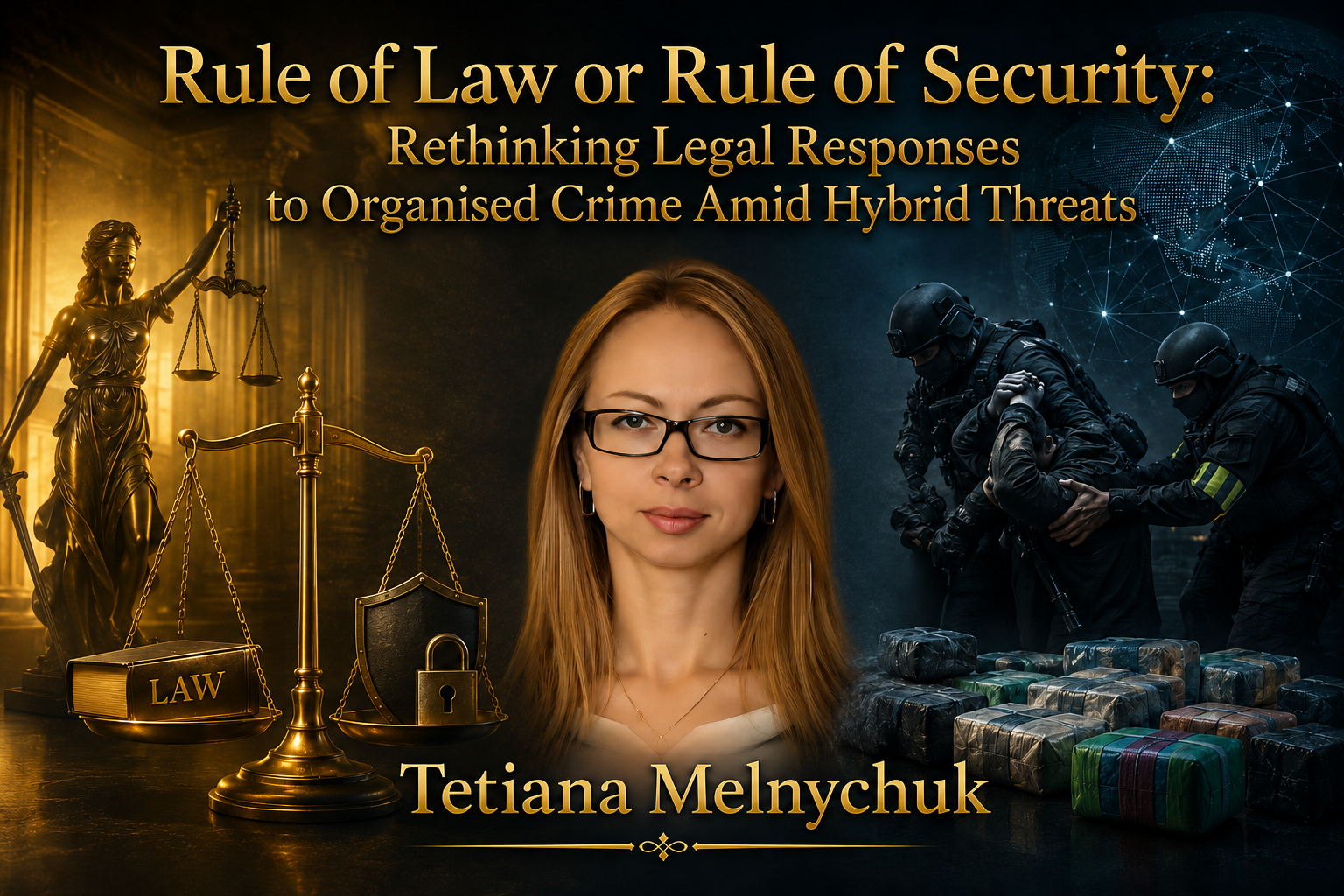
Organised crime in today’s world is evolving into a decentralised and technologically sophisticated phenomenon, more capable than ever before of penetrating strategically important sectors of public administration, the economy and infrastructure, and of adapting to social crises. At the same time, the distinctions between traditional organised crime and more complex hybrid threats, such as political violence, armed conflicts, cyberattacks, propaganda, disinformation and evasion of economic sanctions, are becoming progressively blurred. Criminal networks increasingly act as proxies for hybrid threat actors [8]. However, they do not merely coexist in a geographical space; their symbiotic interaction can trigger a domino effect, producing devastating consequences that extend beyond the initial point of origin.
Active digitalisation, the advancement of AI and recent geopolitical dynamics in Eastern Europe and the Middle East have intensified the issue of crime-related hybrid threats and the appropriate legal responses [1; 9; 12].
EU states are increasingly facing forms of criminality that are taking on hybrid patterns: from the smuggling of conscripts and weapons triggered by Russia’s war of aggression against Ukraine, to interference in domestic political and economic processes through disinformation campaigns and illicit financial flows. The escalation of hybrid threats serves as a catalyst for legal transformation within the EU, given the public demand for security (Communication from the Commission to the European Parliament and the Council on the Seventh Progress Report on the implementation of the EU Security Union Strategy and Annex, COM (2024)). However, the imperative of security, which requires flexibility and rapid adaptation, often conflicts with the law, traditionally focused on stability, consistency and proceduralism.
In response to the growing threats, states continually seek a balance between repressive and preventive countermeasures commensurate with the danger dimension. Nevertheless, there is a noticeable lag in social and legal control over organised crime, particularly considering its trends of transnationalisation. Governments are constrained by regulatory, linguistic, and jurisdictional barriers, the temporality of law, and diplomatic procedures. Criminals, as a rule, do not face such obstacles and actively exploit legal gaps. Under these circumstances, states tend to use security instruments that deviate from the classical approaches to counteraction based on principles of the rule of law more often.
The prioritisation of security facilitates the emergence of the “rule of security”, which can be defined as a legal paradigm in which security becomes the primary normative axis, displacing or marginalising traditional rule of law principles, particularly in response to non-traditional (hybrid) criminal threats. The “rule of security” gives rise to the ambivalence of security: as a legal category, security can both guarantee the rights and freedoms of citizens and restrict them under the pretext of ensuring public order, safeguarding national security or protecting state interests. The issue reflects a broader trend of securitisation in law, which, without critical reflection, risks undermining the foundation of legal legitimacy of crime counteraction.
The phenomenon of securitisation has received considerable attention in political and social sciences [3; 13; 14; 15], including reasonable criticism [2; 11], however, its legal implications in the field of crime prevention remain insufficiently explored.
The concept of the “rule of security” has not yet been systematically doctrinally elaborated in legal studies, although practices in the criminal justice sphere aligned with it are becoming increasingly common.
In particular, numerous contemporary regulatory changes are driven by the implementation of advanced technical security measures. Modern artificial intelligence systems, capable of analysing vast amounts of data, enable the prediction of crime probability in specific regions or based on particular characteristics. Consequently, the paradigm of crime control is shifting: law enforcement is increasingly taking on the nature of predictive control, which in turn raises concerns about a potential erosion of the presumption of innocence.
Moreover, international and regional standards, such as the UNTOC and the ECHR, coexist with national regulatory systems that may differ significantly in their strategies for balancing security and fundamental rights. In some jurisdictions, the boundaries between law, legal exceptions and arbitrariness are becoming increasingly blurred in the context of tackling serious crime.
Furthermore, there is a growing asymmetry in adherence to the rule of law and the effectiveness of security measures across different legal regimes, indicating the transition of emergent regimes to a state of regularity by the institutionalisation of emergency powers. The national margin of appreciation permitted under Article 15 of the ECHR (derogation in time of emergency) should be carefully monitored and framed to avoid abuse of the “rule of security”.
Among others, three areas (though not exclusively) should be highlighted, which illustrate the tension between the need to ensure security and the need to uphold the rule of law.
Firstly, given the digital transformation of organised crime [6; 7] and associated hybrid threats (the use of the dark web for trafficking in drugs, weapons and human organs, the use of crypto-platforms to evade economic sanctions, etc.), a shift in the battlefield towards the cyber space is observed. An increase in security pressure in the cyber domain is anticipated, posing risks to confidentiality, privacy and the protection of personal data.
Secondly, in the geopolitical dimension, there is a growing use of organised crime by certain states to achieve foreign and domestic policy objectives (North Korea, Iran, Russia) or for broader ideological objectives such as international terrorism. State-organised crime [5] creates a peculiar conflict of interest or paradox, where the very institutions tasked with implementing international standards to combat organised crime are themselves part of the problem. Some studies point to a link between authoritarian processes and the growing risk of the abuse of international legal assistance institutions to persecute political opponents [10]. In effect, this constitutes a non-violent undermining of the rule of law from within.
Thirdly, legal measures to combat organised crime in conflict and post-conflict environments are manifestations of crisis management. In conflict-affected jurisdictions, emergency regimes such as martial law are often introduced, significantly restricting constitutional rights and expanding the discretion of security forces. Legislation to combat crime is adopted ‘in the heat of the moment’ or retrospectively without proper legal scrutiny. In post-conflict contexts, organised crime is closely intertwined with political structures, corruption networks and the shadow economy, rendering them even more fragile. Instead of effective reconstruction and the expected rule of law, what occurs is the ‘criminalisation of peace’ [4]. Weakened institutions and high levels of corruption create a security vacuum. In response, risks of the ‘securitisation of peace’ are mounting.
Combating serious and organised crime has transcended the traditional scope of criminal justice, becoming a key issue for safeguarding democratic and legal values. In this regard, it is necessary to reevaluate the extent to which contemporary legal mechanisms for responding to organised crime comply with the requirements of the rule of law, to examine the challenges that the “rule of security” poses to democratic institutions, and to consider what the legal ecosystem of security should look like in response to crime-related hybrid threats.
These developments reflect the growing need for a new legal architecture capable of functioning in conditions of non-linear change and “unstable normality”. They also address the need of a model of adaptive, hybrid threat-resilient legal system that relies on institutional flexibility and transparency, maintaining its democratic nature even under the pressure of exceptional circumstances.
References:
Arkan, Z. (2025). European security and hybrid threats: A narrative in the making. Springer International Publishing.
Balzacq, T. (2005). The Three Faces of Securitization: Political Agency, Audience and Context. European Journal of International Relations, 11, 2, 171-201.
Buzan, B., & Wæver, O. (2003). Regions and powers: The structure of international security. Cambridge University Press.
Cockayne, J. (2013). Chasing shadows: Strategic responses to organised crime in conflict-affected situations (Oslo Forum Papers No. 2). Centre for Humanitarian Dialogue & United Nations University. https://www.hdcentre.org/publications/chasing-shadows/
Decoeur, H. (2018). The phenomenon of state organized crime. In Confronting the shadow state: An international law perspective on state organized crime (online ed.). Oxford University Press. https://doi.org/10.1093/oso/9780198823933.003.0002
Di Nicola, A. (2022). Towards digital organized crime and digital sociology of organized crime. Trends in Organized Crime. https://doi.org/10.1007/s12117-022-09457-y
Europol. (2024). Internet organised crime threat assessment (IOCTA) 2024. Publications Office of the European Union.
Europol. (2025). European Union serious and organised crime threat assessment – The changing DNA of serious and organised crime. Publications Office of the European Union.
Kaldor, M. (2012). New and old wars: Organized violence in a global era (3rd ed.). Polity Press.
Meacham, S. (2022). Weaponizing the police: Interpol as a tool of authoritarianism. Harvard International Review. https://hir.harvard.edu/weaponizing-the-police-authoritarian-abuse-of-interpol/
McDonald, M. (2008). Securitization and the Construction of Security. European Journal of International Relations, 14, 4, 563-587.
Racoveanu, C. (2024). Artificial intelligence – A double-edged sword. Organized crime’s AI vs law enforcement’s AI. Proceedings of the International Conference on Business Excellence, 18(1), 507–517. https://doi.org/10.2478/picbe-2024-0044
Sperling, J. & Webber, M. (2018). The European Union: Security Governance and Collective Securitization. West European Politics. https://doi.org/10.1080/01402382.2018.1510193
Taureck, R. (2006). Securitization theory and securitization studies. European Journal of International Relations, 9(1), 53–61.
Wæver, O. (2007). Securitization and desecuritization. International Security, 3, 66–98.
Tetiana Melnychuk is an Associate Professor at the Department of Criminal Procedure, National University “Odesa Law Academy” (Ukraine), holding a PhD in Law. Her academic and research interests focus on criminal procedural law. She is currently a Visiting Researcher at the University of Osnabrück (Germany), where she pursues comparative legal research in the field of criminal justice.