

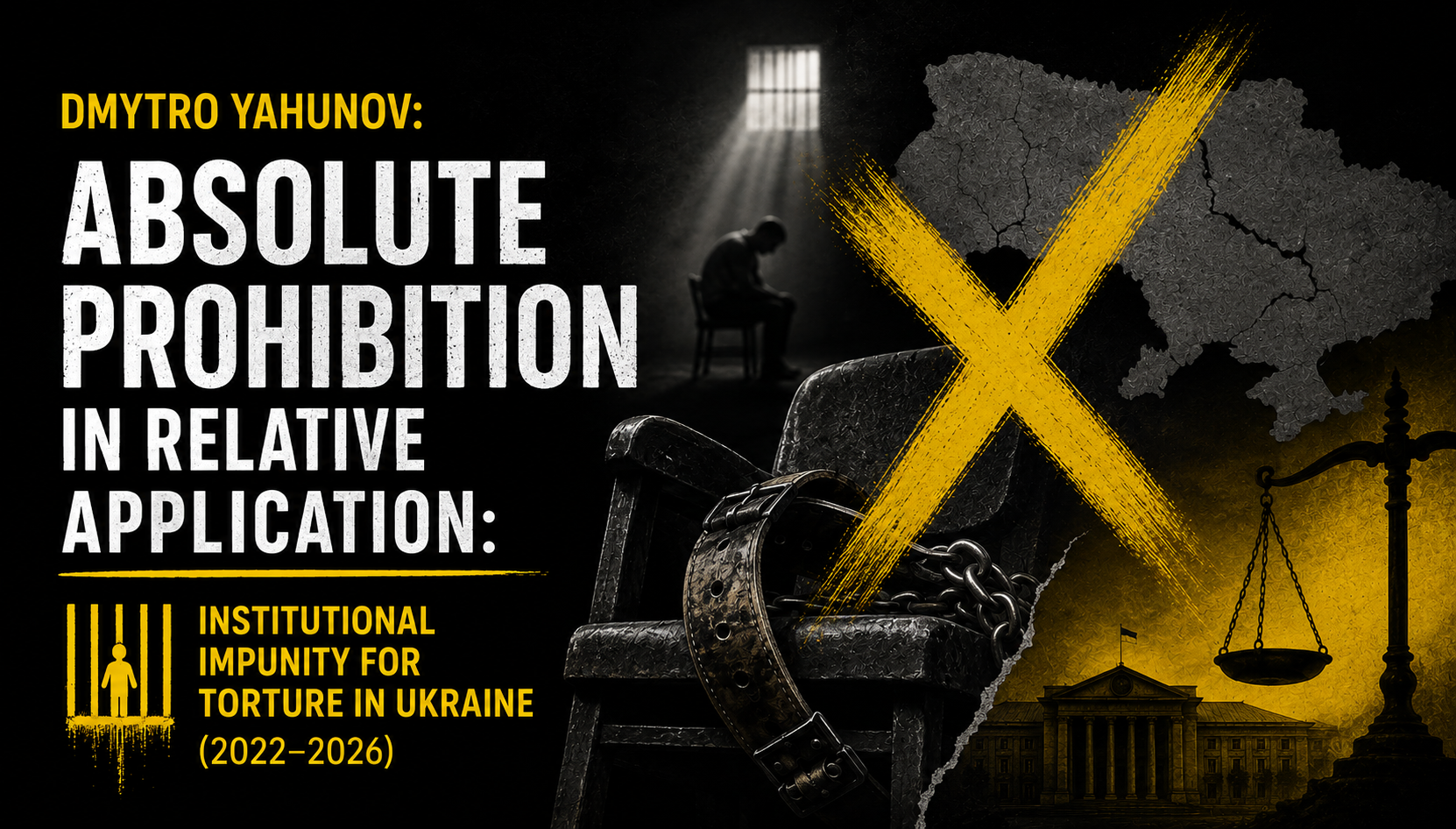
Russia’s full-scale invasion of Ukraine has fundamentally transformed the country’s social and legal landscape. Yet what proved truly alarming was not only the external aggressor — inside the state itself, mechanisms of violence inherited from previous decades continued to operate. Torture in police stations, abuse in penitentiary facilities, beatings of conscripts within Territorial Recruitment and Social Support Centres (TRC/SSC) — none of these phenomena disappeared with the outbreak of war; in some respects they assumed new, even more dangerous forms.
The true scale of the problem is difficult to overestimate. According to the Office of the Prosecutor General of Ukraine, as of early 2026 there were 1,401 criminal proceedings concerning torture pending, of which 704 were opened in 2025 alone (Hlavkom, 2026). At the same time, only a small fraction of cases reach trial: over the entire period from 2022 to 2025, suspicion notices were issued to 56–67 persons per year, while the number of indictments sent to court was significantly lower (Yagunov, 2026). These figures, taken on their own, attest to a systemic crisis in the criminal prosecution of torture.
The onset of the full-scale invasion in 2022 caused a sharp statistical drop in registered crimes of this category — to 68 cases — not because torture had diminished, but because a large share of incidents occurred in occupied or frontline territories where any documentation was virtually impossible (Yagunov, 2026). In subsequent years — 2023–2025 — figures recovered to 94–124 cases per year, consistent with the pre-war baseline, yet far below the actual number of incidents.
The true systemic problem lies not only in the acts of torture themselves, but in the algorithmic inefficiency of their prosecution. The ECtHR, in the case of Afanasyev v. Ukraine, had already established that Ukraine not only applies torture but effectively fails to punish it (Hlavkom, 2026). That verdict has not become obsolete — it is confirmed annually by new scandals, fragile convictions, and the impunity of uniformed torturers.
This review covers the most prominent specific cases in three categories: torture in National Police units, torture in the penitentiary system, and torture in Territorial Recruitment and Social Support Centres (TRC/SSC). Each case is analysed according to a uniform scheme: date and circumstances of the event, description of documented acts, response by authorities and society, suspicion notices issued, and the fate of the case in court.
SECTION I. TORTURE IN NATIONAL POLICE UNITS
The Kaharlik Case: Rape and Torture at a Police Station (2020–2026)
Although the underlying events occurred in May 2020, the Kaharlik police officers’ case became a litmus test for the state of police reform precisely during our study period — owing to its judicial resolution in 2023–2026.
Description of events. In May 2020, at the Kaharlik District Police Department of Kyiv Oblast, two officers — an investigator and the head of the criminal police sector — detained a woman suspected of involvement in a crime. Over an extended period they inflicted grievous bodily harm upon her, applied electric current, handcuffed her to a radiator in the corridor, transported her outside the city in the boot of a car, and raped her. In September–October of the same year, male detainees who had been subjected to torture stated that investigators had also transported them outside the city in car boots and tortured them with electric shocks to extract confessions of theft (LB.ua, 2026; NV, 2026).
The public outcry was unprecedented. The case became a symbol of post-Soviet police violence within the ‘reformed’ police service. The Office of the Prosecutor General placed the case under direct supervision. Both officers were dismissed and taken into custody.
On 24 May 2023 the Kaharlik District Court delivered a guilty verdict: both defendants were sentenced to 11 years’ imprisonment under a combination of charges — torture (Art. 127), unlawful deprivation of liberty (Art. 146-1), and rape (Art. 152 of the Criminal Code of Ukraine) (Hlavkom, 2023). In November 2024, the Kyiv Court of Appeal upheld the sentence (OBOZ.UA, 2024). On 19 February 2026 the Supreme Court of Ukraine definitively confirmed the conviction, drawing a line under 5.5 years of the victim’s judicial struggle for her rights (NV, 2026; LB.ua, 2026). The case became one of the rare examples of torture by police officers being prosecuted to a final, enforceable guilty verdict.
Torture at a Kharkiv Police Station: Sexual Violence to Obtain a Confession
Although this case came to public attention in 2021, its investigative and procedural context spans the study period.
A deputy head of one of Kharkiv’s police divisions detained a man suspected of murder and brought him to the station. For over an hour, officers struck the detainee on the head with a plastic water bottle. The deputy chief then put on rubber gloves and applied sexual violence — squeezing and pulling the victim’s genitals. Unable to endure the torture, the man confessed to killing his acquaintance. The court remanded him in custody, but he secured his release from the pre-trial detention facility and declared his innocence (SBI, 2021).
The SBI issued a suspicion notice to the deputy head of the police division for torture involving sexual violence. The case attracted wide attention owing to the striking resemblance of the ‘interrogation’ methods to Soviet-era militia practices.
Vinnytsia: Torture to the Point of Clinical Death over Suspected Petty Theft (September 2023 – February 2026)
This case is one of the most thoroughly documented examples of police violence in our study period, encompassing all stages — from the crime to the judicial proceedings.
In September 2023, three Vinnytsia police officers were checking information concerning a man’s possible involvement in the theft of a bag containing documents and bank cards. Late at night they brought him to a duty room and commenced what amounted to the ‘beating out of a confession.’ Throughout the night, officers delivered multiple blows with fists and a rubber baton, mostly to the abdomen. The beatings were accompanied by systematic psychological pressure aimed at breaking the person’s will and forcing him to confess. As a result of the torture, the victim sustained multiple severe injuries to internal organs, suffered intra-abdominal haemorrhage, and underwent clinical death — cardiac arrest on the operating table. His spleen was removed (SBI, 2026; TSN, 2026).
Information about the incident only became public in January 2026 — more than two years after the crime itself — when the SBI and the Office of the Prosecutor General released details of the case.
In January 2026, three police officers were served with suspicion notices for torture committed by a group of persons involving a state official, and for the intentional infliction of grievous bodily harm. Two suspects were placed under house arrest; regarding the third, who had already left the police service, the question of issuing a suspicion notice was being resolved. In February 2026 the case was referred to court (OGP, 2026; Dzerkalo Tyzhnia, 2026). A key concern: between the act of torture (September 2023) and the issuing of suspicion notices (January 2026) more than two years elapsed. During this time the victim remained without official victim status in a torture case.
SECTION II. TORTURE IN THE PENITENTIARY SYSTEM
Findings of the Ombudsman’s Office: Special Report 2024
On 2 May 2024 the Office of the Parliamentary Commissioner for Human Rights of Ukraine published a Special Report ‘On the State of Affairs Regarding the Prevention in Ukraine of Torture and Other Cruel, Inhuman or Degrading Treatment and Punishment in 2023’ (Ombudsman, 2024). The document recorded alarming trends that characterised the penitentiary system during the period of martial law.
As of 31 December 2023, 44,024 persons were held in 148 penal institutions and pre-trial detention facilities, compared with 42,726 in 2022. In parallel, 29 penal institutions located in the temporarily occupied territories of Donetsk and Luhansk oblasts remain non-operational (Ombudsman, 2024).
The report documented numerous acts of violence by staff against convicted persons and persons held in custody: beatings with hands, feet, and rubber batons; compulsion to perform physical exercise to the point of exhaustion; threats of sexual violence. Particular concern was raised by the situation of persons sentenced to life imprisonment, who are confined to their cells for 23 hours a day and spend their one-hour exercise period in a cramped cubicle (Focus, 2026; Ombudsman, 2024).
According to data from the Department for the Execution of Criminal Sentences, in 2024–2025 only isolated criminal proceedings under Part 3 of Article 127 of the Criminal Code were opened against institutional staff — 1 in 2024 and a few in 2025 (Pravo.Ua, 2026). This statistical picture is strikingly understated relative to the actual situation, attesting to systemic latency of violence in penitentiary facilities.
ECtHR Judgment: Chornodubravskyy and Others v. Ukraine (2026)
In 2026 the European Court of Human Rights delivered judgment in the case of Chornodubravskyy and Others v. Ukraine concerning 12 applicants. The Court found a violation of Article 3 of the Convention owing to cell overcrowding, absence of sanitary conditions, lack of access to showers and fresh air in Ukrainian pre-trial detention facilities (Pravo.Ua, 2026). This judgment continues a long series of analogous ECtHR verdicts, including the case of Sukachov v. Ukraine (2020), and confirms the systemic nature of violations in the domestic penitentiary system.
Statistical Overview (2022–2026)
Aggregating available data, as of early 2026 courts had delivered only 20 final convictions in cases of torture by law enforcement officers — across the entire observation period (Hlavkom, 2026). Police officers feature most frequently in such proceedings, accounting for approximately three-quarters of all suspicion notices. Penitentiary staff rank second, accounting for at least 36 cases in 2025 (Hlavkom, 2026). Meanwhile, researchers note that registered data for 2022–2025 are significantly understated, since they cover only incidents that occurred on government-controlled territory where investigation is possible (Yagunov, 2026). The actual number of torture incidents — in police stations, prisons, and especially in TRC facilities — remains unknown.
SECTION III. TORTURE IN TERRITORIAL RECRUITMENT AND SOCIAL SUPPORT CENTRES (TRC/SSC)
Systemic Violence as a ‘New Front’: The General Picture, 2023–2026
With the onset of large-scale mobilisation in 2023, a new wave of scandals connected to violence inside TRC/SSC facilities came to public attention. The Office of the Parliamentary Commissioner for Human Rights recorded that in 2022–2023 more than 500 applications were received from citizens regarding rights violations during mobilisation. In 2024 this number increased sixfold — to 3,312 complaints — and in 2025 it reached 6,127 applications (UNIAN, 2026). In total, over 2022–2025 the Ombudsman received nearly 12,000 complaints about TRC actions.
Ombudsman Dmytro Lubinets described mobilisation in 2025 as the ‘most acute issue’ his office had faced, emphasising that ‘Ukrainian citizens must feel protected within TRC/SSC premises, not the opposite’ (RBK-Ukraine, 2026). The SBI characterised combating torture in TRCs as one of its ‘priority areas,’ noting: ‘Such actions are inadmissible, especially under martial law, and undermine public trust in state institutions’ (SBI, 2026).
Ternopil: Video Recording of the Beating of Conscripts at a TRC (October 2023 – May 2026)
On 7–8 October 2023 footage of the beating of conscripts — recorded the previous day — circulated online. Criminal proceedings were opened the following day. A verdict was delivered in October 2026 (Zaxid.net, 2026; Radio Svoboda, 2023).
On the evening of 6 October 2023, a grenadier soldier from the TRC security section, together with other service personnel, stopped a local resident in central Ternopil for a documents check. The man was brought to the TRC. In footage covertly recorded and subsequently published on social media, two servicemen are seen brutally beating two men lying on beds; pleas not to be beaten are audible. One victim sustained medium-severity bodily injuries; the other sustained minor injuries (SBI, 2024; NV, 2024).
The video provoked wide public reaction. Ombudsman Lubinets personally announced an inspection, writing on Facebook: ‘Ternopil. I saw footage from the media and social networks showing the beating of conscripts. This must not happen!’ (Radio Svoboda, 2023). The Ternopil Specialised Prosecution in the Defence Sphere of the Western Region opened criminal proceedings. On 13 October 2023 a court imposed night-time house arrest on two suspects — the section commander and the grenadier soldier.
In early 2024 the accused returned to work at the TRC pending the conclusion of the trial. The case was substantially delayed, and several witnesses had left the country. On 20 May 2026 the Ternopil City-District Court delivered its verdict: both defendants pleaded guilty and received 1-year suspended sentences and a fine of UAH 850. In determining the sentence the court took into account the defendants’ combat record, the presence of children, their sincere remorse, and documented donations of UAH 50,000 each to the Armed Forces of Ukraine (Zaxid.net, 2026). This verdict became a symbol of impunity in cases of violence at TRCs: the minimal punishment for a documented and publicly circulated brutal beating proved so disproportionate to the social harm caused that the case triggered a fresh debate on judicial independence in cases against members of the security forces.
Verkhovyna TRC (Ivano-Frankivsk Oblast): Systemic Torture and Extortion (November 2025 – May 2026)
Following verification of complaints from citizens and members of parliament regarding beatings, torture, and extortion of money at one of the Prykarpattia TRCs, the SBI launched an investigation. It established that a lieutenant-colonel, deputy head of the Verkhovyna District TRC/SSC, had systematically humiliated and beaten conscripts. One victim — a service member — publicly spoke out about the violence. The investigation established that at least four subordinates of the lieutenant-colonel were involved in the beatings (Suspilne Ivano-Frankivsk, 2026). On 21 November 2025 the lieutenant-colonel was detained and remanded in custody. The SBI noted that after media publications and official appeals, an increasing number of victims began contacting law enforcement. In January 2026 another subordinate of the lieutenant-colonel — a serviceman from the security platoon involved in the beatings — was detained. The actions of the commander and three subordinates were classified as torture committed by a state official. The court remanded all persons charged in custody without the right to bail. On 18 May 2026 the SBI referred the indictment to court (Podrobnosti, 2026; Leopolis News, 2026). On 29 May 2026 a preparatory hearing took place at which the second victim appeared for the first time; the court granted an application for panel adjudication (Pravda.If.Ua, 2026).
Ternopil (Second Episode): Torture at a TRC with Fluoroscopy and Organ Removal (2025–2026)
The SBI conducted an inspection in response to citizens’ complaints of beatings, torture, and extortion of money at one of the district TRCs. At least two criminal episodes were established. In the first, the victim was beaten for refusing to undergo a fluoroscopic examination: initially in the corridor of a hospital, then on TRC premises. In the second, servicemen forcibly detained a man; the commander personally delivered blows; tear gas was deployed; the victim lay on a concrete floor. As a result of the injuries sustained, he underwent complex surgery involving the removal of one of his organs (Leopolis News, 2026; Focus, 2026). Suspects were served with suspicion notices in November 2025 and January 2026. Following media publications, the number of victims approaching law enforcement increased.
Kharkiv TRC: Torture and Shooting, Extortion of Money (April 2026)
The SBI issued suspicion notices to a group of servicemen from one of Kharkiv’s district TRCs, as well as to servicemen from other units who had acted in concert. Among those charged was a major of the TRC who held a commanding position and organised the actions of the accomplices. According to the investigation, the group extorted money from individuals and, in cases of refusal, resorted to violence and threats. Shooting episodes were also recorded in the case. Suspicion notices were issued for torture committed by prior conspiracy by a group of persons (SBI, 2026; Hlavkom, 2026). The pre-trial investigation was ongoing, with prosecutorial supervision exercised by the Kharkiv Specialised Prosecution in the Defence Sphere of the Eastern Region.
Mykolaiv: TRC Officer Suspected of Beatings (January 2026)
On 8 January 2026 the SBI issued a suspicion notice to an officer of one of Mykolaiv’s district TRCs for beating and humiliating conscripts (Hlavkom, 2026). The SBI reiterated that ‘combating torture is one of the Bureau’s priority areas’ and that such actions ‘undermine public trust in state institutions’ (SBI, 2026).
Kyiv Oblast: TRC Officer for Beating and Humiliation (February 2026)
On 3 February 2026 the SBI detained and served a suspicion notice on the head of the civil-military cooperation support group of one of the Kyiv Oblast district TRCs for beating and systematic humiliation of conscripts (SBI, 2026). The case demonstrates that violence at TRCs is not a local anomaly but a widespread practice across different regions of the country.
Rivne TRC: Beating with a Bat and Corruption (May 2025)
In May 2025 the SBI issued additional suspicion notices to the former head of the Rivne District TRC. Initially criminal proceedings had been opened against him for beating one of his subordinates with a bat. During a search, narcotics were discovered. A further charge concerned assisting persons in evading mobilisation: ‘The official created conditions enabling certain conscripts to avoid mobilisation’ (ArmyInform, 2025). This case illustrates the typical ‘compounded corruption’ of TRCs: violence combined with corrupt schemes to evade service.
Dnipro: Beating at TRC, Video on Telegram (August 2025)
On 8 August 2025 a Telegram channel published footage apparently showing the beating of a former serviceman by Dnipro TRC employees. The Dnipro Specialised Prosecution in the Defence Sphere immediately registered criminal proceedings (Donbas Patriot, 2025). The case is instructive: footage in public messaging applications became the primary ‘trigger’ for opening proceedings.
SECTION IV. STATISTICAL DIMENSIONS AND SYSTEMIC CONCLUSIONS
Quantitative Picture, 2022–2025
According to official data of the Office of the Prosecutor General as of early 2026 (Hlavkom, 2026), the total number of criminal proceedings regarding torture currently pending is 1,401, of which 704 were opened during 2025. The number of persons served with suspicion notices was 56 in 2022 and 67 in 2025; 41 indictments were referred to court in 2025. The total number of final guilty verdicts over the entire study period is 20. These indicators demonstrate an extremely low rate of criminal prosecution effectiveness: of more than 1,400 proceedings opened, only 20 resulted in a final conviction — a ‘verdict-to-proceeding’ conversion rate of less than 1.5%.
Structural Causes of Impunity
Analysis of the documented cases reveals several systemic factors that perpetuate the impunity of torture in Ukraine even in conditions of prolonged human rights advocacy and declared reforms.
First, protracted investigations. In the Vinnytsia case, more than two years elapsed between the act (September 2023) and the suspicion notice (January 2026). In the Ternopil TRC case, between the video (October 2023) and the verdict (May 2026) — almost three years. Procedural delay exhausts victims and increases the risk of evidence loss.
Second, disproportionate penalties. The verdict in the Ternopil TRC case (a 1-year suspended sentence and a UAH 850 fine for a documented and filmed brutal beating) plainly demonstrates that courts do not always adequately assess the social danger of torture committed by state officials.
Third, fear and latency. The Ombudsman’s Office, the SBI, and independent researchers unanimously indicate that the actual number of torture incidents is many times higher than the registered figure. Victims fear repeated persecution, lack confidence in the system’s effectiveness, and under conditions of martial law may find themselves in a state of dependency on the very structures that abused them (Yagunov, 2026).
Fourth, institutional loyalty. The return of the accused in the Ternopil TRC case to their workplaces before the verdict became enforceable, justification on circumstantial grounds, and similar practices — all attest to the fact that certain institutions continue to protect ‘their own’ and resist external oversight.
Fifth, the systemic character of violence at TRCs. The increase in complaints from 500 in 2022–2023 to 6,127 in 2025 (UNIAN, 2026) signifies not only a greater willingness of people to complain, but also a genuine spread of violent practices in the context of large-scale mobilisation.
CONCLUSIONS
This documentary review of the most prominent cases from 2022–2026 paints a grim picture of systemic violence and corporate impunity within Ukraine’s key security institutions. The police, the penitentiary service, and the TRCs — three separate agencies with no organisational connection — demonstrate identical patterns of behaviour: the application of physical pain to obtain a desired result (confessions, compliance, money); minimisation of the risk of accountability; and loyalty of leadership towards subordinate torturers.
The reform of the SBI that is under way and the increased activity of the defence-sphere prosecution are positive signals. However, without overcoming systemic impunity — through strengthening judicial independence, legislative reinforcement of the inevitability of punishment for torture, and genuine functional parliamentary and public oversight — any reforms will remain cosmetic.
Ukraine has assumed obligations before the Council of Europe, the ECtHR, and, potentially, towards its future EU membership. Fulfilment of those obligations requires not merely a statistical increase in the number of suspicion notices, but the genuine punishment of torturers — irrespective of their rank and institutional affiliation.
REFERENCES
20 Khvylyin Vinnytsia. (2026, April 7). Clinical death after interrogation: how the case is progressing against Vinnytsia police officers who tortured a suspect [in Ukrainian]. https://vn.20minut.ua/Kryminal/klinichna-smert-pislya-dopitu-yak-yde-sprava-schodo-politseyskih-yaki–11992753.html
ArmyInform. (2025, May 8). The former TRC commander who beat a subordinate with a bat was served with another suspicion notice — SBI [in Ukrainian]. https://armyinform.com.ua/2025/05/08/kolyshnomu-nachalnyku-tczk-yakyj-byv-bytoyu-pidleglogo-povidomyly-pro-shhe-odnu-pidozru-dbr/
Donbas Patriot. (2025, August 12). Possible beating of former serviceman by TRC employees in Dnipro: criminal proceedings opened [in Ukrainian]. https://donpatriot.news/mozhlyve-pobyttya-kolyshnogo-vijskovosluzhbovczya-praczivnykamy-tczk-u-dnipri-rozpochato-kryminalne-provadzhennya
Focus. (2026, January 7). Mobilisation in Ukraine: TRC servicemen tortured a man for refusing a fluoroscopy [in Ukrainian]. https://focus.ua/uk/voennye-novosti/739562
Hlavkom. (2023, May 24). Rape in Kaharlik: court handed down verdict against former police officers [in Ukrainian]. https://glavcom.ua/kyiv/news/zhvaltuvannja-u-kaharliku-sud-vinis-virok-ekspolitsejskim–929569.html
Hlavkom. (2026, April 22). Case of torture and shooting in Kharkiv: TRC employees charged with suspicion [in Ukrainian]. https://glavcom.ua/country/criminal/sprava-pro-katuvannja-i-striljaninu-v-kharkovi-pratsivniki-ttsk-otrimali-pidozru-1115283.html
Hlavkom. (2026, March 6). Cases of torture by law enforcement officers: the Prosecutor General’s Office published statistics [in Ukrainian]. https://glavcom.ua/country/criminal/spravi-pro-katuvannja-pravookhorontsjami-ofis-henprokurora-opriljudniv-statistiku-1106707.html
Informator Ivano-Frankivsk. (2026, May 18). Head of one of the district TRCs in Frankivsk region and three subordinates to stand trial [in Ukrainian]. https://if.informator.ua/2026/05/18/sudytymut-kerivnyka-odnogo-iz-rajonnyh-tczk-frankivshhyny-ta-troh-jogo-pidleglyh
LB.ua. (2026, April 6). Former head of prison in Luhansk region who tortured Ukrainian POWs served with suspicion notice [in Ukrainian]. https://lb.ua/society/2026/04/06/731212_povidomleno_pro_pidozru.html
LB.ua. (2026, February 19). Supreme Court upheld verdict against former police officers in the Kaharlik torture and rape case [in Ukrainian]. https://lb.ua/society/2026/02/19/723268_verhovniy_sud_zalishiv_sili.html
Leopolis News. (2026, May 18). TRC commander and three servicemen to stand trial in Prykarpattia for torturing conscripts [in Ukrainian]. https://leopolis.news/na-prykarpatti-sudytymut-kerivnyka-tczk-ta-troh-vijskovyh-za-katuvannya-mobilizovanyh/
NV (New Voice of Ukraine). (2026, February 19). Supreme Court draws a line under the Kaharlik police case [in Ukrainian]. https://nv.ua/ukr/ukraine/events/verhovniy-sud-postaviv-krapku-v-spravi-ekspoliciyantiv-yaki-zgvaltuvali-zhinku-v-kagarliku-50585359.html
NV (New Voice of Ukraine). (2024, November 4). The torture and rape case at Kaharlik Police Station — court dismissed appeal by former officers [in Ukrainian]. https://incident.obozrevatel.com/ukr/crime/sud-vidhiliv-apelyatsiyu-kolishnih-politsejskih
Office of the Parliamentary Commissioner for Human Rights of Ukraine (Ombudsman). (2024, May 2). Special report on the state of affairs regarding the prevention of torture and other cruel, inhuman or degrading treatment and punishment in Ukraine in 2023 [in Ukrainian]. https://www.yagunov.in.ua/ombuds-2024/ [Summary by Yagunov, D.]
Podrobnosti. (2026, May 18). TRC employees to stand trial in Prykarpattia for beating and torture [in Ukrainian]. https://podrobnosti.ua/2515825-na-prikarpatt-suditimut-pratsvnikv-ttsk-cherez-pobittja-ta-katuvannja.html
PRAVDA.IF.UA. (2026, May 29). The torture case at Verkhovyna TRC: how the hearing proceeded [in Ukrainian]. https://pravda.if.ua/sprava-pro-katuvannya-u-verhovynsiokomu-tczk-yak-prohodyv-sud/
PRAVO.UA. (2026, February 23). Bohatyr, V. The Ukrainian penitentiary system: between statistics and the standards of the European Convention [in Ukrainian]. https://pravo.ua/ukrainska-penitentsiarna-systema-mizh-statystykoiu-i-standartamy-ievropeiskoi-konventsii-bloh-volodymyra-bohatyria
Radio Svoboda. (2023, October 9). Criminal proceedings opened over beating of conscripts at Ternopil TRC — Prosecutor General’s Office [in Ukrainian]. https://www.radiosvoboda.org/a/news-ternopil-tck-pobyttia-mobilizovanykh/32628230.html
RBK-Ukraine. (2026). Lubinets stated that complaints about mobilisation violations increased 333-fold [in Ukrainian]. https://www.rbc.ua/rus/news/skargi-porushennya-mobilizatsiyi-zrosli-333-1778661505.html
State Bureau of Investigations (SBI). (2021, September 30). SBI suspects Kharkiv police official who perversely tortured a man at a police station [in Ukrainian]. https://dbr.gov.ua/news/dbr-pidozryue-posadovcya-harkivskoi-policii-yakij-iz-zbochennyam-katuvav-cholovika-u-viddilenni
State Bureau of Investigations (SBI). (2024, January 8). SBI referred to court the case of torture of men at the Ternopil TRC [in Ukrainian]. https://dbr.gov.ua/news/
State Bureau of Investigations (SBI). (2026, April 22). SBI announced suspicion in the case of torture and shooting in Kharkiv involving TRC servicemen [in Ukrainian]. https://dbr.gov.ua/news/katuvannya-ta-strilyanina-u-harkovi-za-uchasti-vijskovosluzhbovciv-tck
State Bureau of Investigations (SBI). (2026, February 3). SBI charged a district TRC officer in Kyiv region for beating and humiliating conscripts [in Ukrainian]. https://dbr.gov.ua/news/dbr-povidomilo-pro-pidozru-oficeru-rajonnogo-tck-kiivshhini-za-pobittya-ta-prinizhennya-vijskovozobovyazanih
State Bureau of Investigations (SBI). (2026, January 26). SBI exposed Vinnytsia police officers: torture and clinical death [in Ukrainian]. https://www.myvin.com.ua/news/45433
State Bureau of Investigations (SBI). (2026, January 7). Mobilisation in Ukraine: TRC servicemen tortured a man for refusing a fluoroscopy [in Ukrainian]. https://focus.ua/uk/voennye-novosti/739562
State Bureau of Investigations (SBI). (2026, January 8). SBI charged TRC officer in Mykolaiv with beating of conscripts [in Ukrainian]. https://glavcom.ua/country/incidents/dbr-oholosilo-pidozru-ofitseru-ttsk-u-mikolajevi-za-pobittja-vijskovozobovjazanikh-1097025.html
Suspilne Dnipro (Public Broadcasting). (2026, March 18). TRC forced conscription in Dnipro: what the police bodycam video revealed [in Ukrainian]. https://suspilne.media/dnipro/1257444
Suspilne Ivano-Frankivsk (Public Broadcasting). (2026, April 2). Lt.-Colonel Chornei of Verkhovyna TRC, suspected of torture, kept in custody [in Ukrainian]. https://suspilne.media/ivano-frankivsk/1255284
Suspilne Ivano-Frankivsk (Public Broadcasting). (2026, January 7). Torture at TRC in Frankivsk region: SBI detained another suspect [in Ukrainian]. https://suspilne.media/ivano-frankivsk/1207794
TSN. (2026, January 26). In Vinnytsia three law enforcement officers beat a theft suspect during interrogation, causing clinical death [in Ukrainian]. https://tsn.ua/ukrayina/u-vinnytsi-pravookhorontsi-pid-chas-dopytu-dovely-pidozriuvanoho-do-klinichnoyi-smerti-3008084.html
UNIAN. (2026). The Ombudsman’s Office received almost 12,000 complaints about TRC actions during mobilisation in Ukraine [in Ukrainian]. https://www.unian.ua/society/mobilizaciya-v-ukrajini-stalo-vidomo-skilki-skarg-podali-ukrajinci-na-diji-tck-13378455.html
Yagunov, D. (2026, January 25). The paradox of war: the effectiveness of criminal prosecution for torture in Ukraine (2013–2025) [in Ukrainian]. https://www.yagunov.in.ua/paradox-prosecution-torture/
Zaxid.net. (2026, May). Two servicemen from Ternopil received a suspended sentence and a fine for brutally beating conscripts [in Ukrainian]. https://zaxid.net/za_zhorstoke_pobittya_mobilizovanih_dvoye_viyskovih_z_ternopolya_otrimali_ispitoviy_termin_i_shtraf_n1637832